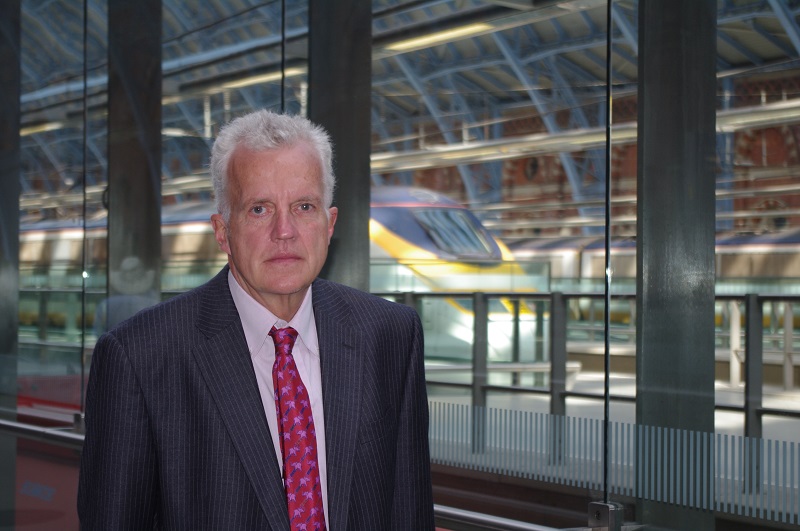
Just been to a briefing with a very tired looking Richard Brown, the head of Eurostar, and Chris Garnett (the former boss of GNER, not Network Rail as reported in the Guardian) who is conducting, along with a French colleague, the enquiry into what happened. He is hoping to publish the report by the end of January but that is a very tight schedule given how much there is to investigate.
There is not only the initial breakdowns, but the response of the onboard teams, the maintenance of the trains, whether the weather conditions were really that unique, the subsequent handling of the delayed passengers, the cancellation of all the trains, and so on.
Richard Brown was very circumspect about what work had precisely been carried out to mitigate the problems. The suggestion I have made several times in broadcasts that maintenance issues may be involved is, I suspect, close to the mark. The failure of five trains is obviously absolutely exceptional but does suggest that rather more than mere weather conditions are at fault. Brown told us that the failure was in a component called the motor block, whereas previous similar failures had been in the common block, a different part of the electronics.
Already, Eurostar compounded its initial cock ups by announcing yesterday that only people who had booked for the weekend would be allowed on the trains. That was daft. It was obvious that many people would have made alternative arrangements – see previous entry on this website about Eurolines running lots of extra coaches which was hardly mentioned in the press, as well as BA flying a 747 between London and Paris – and so I bet trains have been leaving without being full. So then halfway through yesterday, Eurostar announced that it would except Monday tickets for Tuesday train. Then, having said it would clear the backlog, it then said that not everyone would be accommodated.
This is characteristic of the whole exercise. There has been a real absence of leadership and of can-do spirit. There is bound to be changes in leadership at Eurostar, but it may take more than that to change the culture.
Popularity: 55% [?]


35 Responses
In July 2006, I got to Waterloo International, only to hear repeated announcements that said in essence: “Dear ex-customer, there’s a building on fire somewhere between London and the Tunnel, would you please go away and not come back for a few days, if at all”. It didn’t seem to occur to anyone that
a) not traveling is not an option if you work, live, have a family the other side of the channel.
b) even if it is an option, where do you find reasonably-priced hotel rooms for 20,000 stranded passengers in Paris, Brussels or London in July?
c) many of the passengers were visibly not used to travelling and were completely lost due to language problems or sheer panic.
As I was in class a) I decided to take the first train I could from Waterloo East to Ashford International and try my luck there. I found out that Eurostars were, as I hoped, terminating there and returning to Brussels and Paris. No one had bothered to tell the staff in London. Or those in Ashford for that matter. I had some surreal conversations with people who assured me that no Eurostars were due to stop there against a backdrop of those exact same trains waiting at the platforms. I finally got to Brussels a few hours late that same day. The unfortunate people who listened to Eurostar’s advice were probably tucking themselves up for the night under Waterloo Bridge.
The thing that struck me most about the present problems was the total lack of any change: Eurostar’s whole PR machine immediately went into the “Please go away” mode instead of “This is how we’re going to get you to the other side” one. They don’t seem to be able to grasp that travellers will excuse a delay, even a long one, if they are kept informed and assisted in going where they need to go, even if it’s by another means of transport. I would gladly have rowed over…
The media have spoken abundantly of the staff’s inability to keep passengers informed, the lack of means to get the trains out of the tunnel, and delays once they had been extracted. Some additional questions I feel the enquiry needs to answer are:
- Is the fact that only one model of train is allowed to run through the tunnel not a contributing factor. If other trains (ICEs, or simply “normal” trains) were equipped and authorised to run in the tunnel, a smaller proportion of trains may have broken down in the first place and services could have resumed as soon as the tunnel was clear with an “immune” type of equipment.
- What is the influence of the UK not being part of the Schengen Agreement on the current fiasco? Could it be that passengers were kept inside trains because they couldn’t be processed by customers? Were they refused food and drinks because the shops were in another country?
It is very obvious that the sheer number of people stranded makes any closure of the service a catastrophe and alternative solutions need to be prepared. This probably entails a number of measures:
- Revisit Eurostar’s propensity to shut down all operations for a number of days when things go wrong.
- Ensure that alternative material can be used if Eurostar does close down operations. This would obviously mean changing some rules and regulations, and probably knocking a few heads together to get it done. Obviously, this would mean using machines capable of running with the TVM and other necessary control systems.
- Have arrangements with alternative transport companies (airlines, ferries, coaches) to take over all or part of the passengers (and accept their tickets at no extra cost)
If Eurostar is unable to take responsibility for this, possibly another organisation should take over these tasks.
Posted on December 23rd, 2009 at 6:43 pm
well put Ian – occurs to me that in BR days the channel tunnel freight locos (class 92?), no doubt built at great expense with some taxpayer subsidy somewhere along the line – would have been designed to be able to ‘drag’ the passenger trains out or through to final dest – even at reduced speed obviously. Not sure if they are all mothballed these days due to EWS / DBS issues? Daft if they are of course, given their flexibility and obvious tunnel safety compliance.
Posted on December 23rd, 2009 at 7:09 pm
Yes, class 92 locomotives still exist (Eurostar got rid of theirs as they could see no utility in them!) but they are used around the country and, as far as I know, could be used not only in the Channel Tunnel but all the was to St Pancras and in France. Presumably, they could also haul “conventional” passenger carriages if such a crime were allowed by the rather prudish authorities. Note, conventional trains run through the Loetschberg and other major tunnels throughout Europe without catastrophic consequences. Perhaps what we need is a pan-European standard for trains able to run through tunnels rather than separate ones for each tunnel.
I was also thinking of the 395 class that runs on HS1. Surely that could make its way as far as Calais Fréthun or Lille where passengers could transfer to TGVs (or Eurostars). Not ideal, but better than no service at all!
Posted on December 23rd, 2009 at 7:31 pm
I forgot to mention, the ICE 3 trainsets that run from Frankfurt to Paris. They could probably make if from Paris or Brussels to Ebbsfleet (They couldn’t enter St. Pancras, because it doesn’t run under TVM420). and exchange passengers there.
Obviously, some commissioning would need to be done for these trains, but probably few hardware or software changes. And the idea would only be to use them in case of an emergency to keep passengers flowing through the tunnel.
Obviously, if new operators appear, linking London with other towns in Europe, they may bring with them equipement which can travel all the way. But a standardisation of requirements would still make their job easier (and increase the probability of this happening)
Posted on December 23rd, 2009 at 7:43 pm
It doesn’t help that Eurostar have that peculiar French fetish for compulsory reservations and no standees, despite each train having two large buffet cars with plenty of standing room. If they operated like a normal Intercity train, they’d move a lot more people. It’s not ideal having to stand on a packed train for two hours, but I’ve done it before (usually thanks to disruption, with some notable exceptions (FGW seem particularly prone to routinely creating this sort of situation through a combination of stupid stopping patterns and stupider fares rules)), and in the end it’s preferable by far to waiting for some hypothetical train with seats. After all, there’s no take-off and landing on a train, so seating is just a matter of passenger comfort and expectations.
Posted on December 23rd, 2009 at 9:15 pm
To Dan (and others: I put this on the other blog – no 4 and no. 9)
Re the debate: train Paris to Calais then foot passenger on boat then train Dover to London. Dan, I have done that route. 5 km is not so far to walk to the port but it feels a bit strange as the port (like most) is a touch barren. But there is a bus service to the boats from the town that I could have taken as there are lots of foot passengers who go regularly from Kent I think. I would find it hard to believe that the Guardian blogger you mentioned could not get on the boat as a foot passenger as I have traveled on one or other ferries but never found them full up to foot passengers. I think if I were a BBC editor I would have sent someone down there to see what alternatives were available – why not ? – Also to Victoria to see how the coaches to Europe were doing (there are hundreds of route coming and going all day and night). As to why the BBC should advise. BBC is a ‘public service’ there to ‘inform’ entertain and educate – I believe are the founding principles – not just report on the ’sexed up’ version! “abandoned passenger at St Pancras etc” Ha!
Come on Christian Wolmar – why not do a story for us about those who found other ways home? After all, until 15 years ago most people went this way – train and boat ! People need to know the options for future reference – not least the Eurostar ‘managers’ who could have organised boats, trains and coaches (and the Red Cross) surely as a contingency plan???????
I have one more question… I was caught up with the Eurostar tunnel fire that day in 2008 and indeed taking the Paris Calais train then boat, then Dover to London by train was how I got back. And I got my Eurostar refund with no problem.
But I never heard reported the results of the inquiry into that debacle in our news. I believe the inquiry was set up in France as it happened on their side of the tunnel. Does Christian Wolmar or anyone on this blog know what the result of the inquiry was? Many thanks Sandi
Posted on December 23rd, 2009 at 11:27 pm
I have often taken the ferry as a foot passenger without any problem.
Besides the Dover routes, I have also taken the Newhaven to Dieppe and Portsmouth to Le Havre routes (The night boat is particulary agreable as you can sleep aboard). It is quite easy to get from any of the French ports to Paris.
I believe there are also ferries to Dunkerque and Oostende (for Brussels) but I have never tried these.
Posted on December 24th, 2009 at 4:50 pm
Norfolkline run from Dover to Dunkerque quite regularly, and were one of only two ferry operators running from Dover on the 19th. (Seafrance and P&O both run to Calais, which was closed for a while.) I drove with the family to Italy using Norfolkline on the evening of the 19th and, aside from a (wholly predictable; Dover often gets backed-up even on a good day during peak periods) 5-hour queue on the A2 near Dover, we managed to complete our journey with little trouble. The weather in France, however, was approaching blizzard conditions and was not fun to drive through.
Contingency planning is difficult as it relies on making educated guesses about what might possibly go wrong. The weekend’s events were something of a “perfect storm”: five trains—all from the French side—failed in rapid succession, wiping out all margin for error. The port of Calais was shut down. Snow—a well-known bête noir of Kent’s infrastructure—added to the problems.
Dover, which often sees tailbacks up both the A2 and A20 during peak periods, was already suffering from the closure of Calais, so sending passengers that way wasn’t an ideal solution.
So, another question: Why couldn’t Seafrance and P&O divert to other French ports while Calais was closed? Boulogne and Dunkerque were still open and both have suitable docking facilities and there was nothing wrong with the ferries.
What about services from Ramsgate and other ports? Would reopening a small satellite cross-channel port at Folkestone not be a good idea in the name of redundancy and flexibility?
Road gritting seemed to be working well, but with Operation Stack in place, this left only the A2 and A20 to cope with the masses of travellers heading for the one remaining point of failure to France.
Kent’s notoriously poor rail network—which has zero redundancy—went tits-up as usual. It only takes one train to fail on a two-track line with no bi-directional signalling for services to fall apart very quickly. Again, why hasn’t this issue ever been rectified? The cheap-and-nasty nature of Kent’s classic rail network isn’t exactly a secret.
Yes, Eurostar, Eurotunnel and SNCF need to raise their game, but *nobody* came out of this smelling of roses. Kent’s road network showed its inadequacies. Dover’s increasingly congested and constrained port infrastructure proved unable to cope. Network Rail’s classic rail routes were a mess. Buses and coaches were just as snarled up in the congestion as everyone else. Communication was truly awful *across the board*. (Try as I might, I simply could not find a single point of information about sailings from Dover. Aside from “Congestion on A2 from A256 intersection”, there was NOTHING about the level of service from the Port of Dover itself.)
Posted on December 24th, 2009 at 11:13 pm
Wasn’t the attitude shown towards its passenger by Eurostar supposed to be one of the thing that privatisation would bring an end to?
Posted on December 24th, 2009 at 11:41 pm
Ian Griffiths & others.
Eurostar operate on a “Command and Control” syle, with employees kept informed (or under-informed) on a strict “Need to Know” basis.
Needless to say, when anything goes wrong it falls down in a very big heap.
Don’t blame the train/platform staff – they are deliberately kept almost as much in the dark as the paying passengers.
THIS is what has got to change – and is least likely to.
Also, Eurostar STILL think theyr’e an airline – NOT a good model to follow!
Posted on December 25th, 2009 at 3:25 pm
According to a close friend who is a Eurostar engineer, the answer to the question “about what work had precisely been carried out to mitigate the problems” was “Gaffa tape and polythene”. The second bodge job was that the testing done to the modified trains running with the polythene were run in much warmer temperatures meaning that they worked without any problem! It is also true that in 2001, there were similar problems but nothing was put in place after. The final cock up by Eurostar was to sell the rescue trains in a cost saving mesure a few years back!
Posted on December 26th, 2009 at 12:05 am
Having read the full press statement from Eurotunnel about the failings of Eurostar I am still left feeling that we have been told a pack of lies about the incidents.
Why was it, for example, that the fourth and fifth trains to fail, blocking the second tunnel with failures 2 and 3 inside the first tunnel, happened at 0051 and 0055?
This was no mechanical or snow failure but something more disturbing and sinister.
Eurotunnel release also points out the unprecendented time taken by Kent police, who also must have presumed foul play of some kind, conducting “a series of incomprehensible and interminable checks and controls”.
Nor am I convinced by the full day or more of test running after “modifications”.
I would like to be told the truth.
One breakdown may be unfortunate, a second, third, fourth and fifth smacks of something much more serious which could damage Eurostar customer confidence for a long time.
Who will be the first to tell us the truth?
Posted on December 26th, 2009 at 6:15 pm
Sorry to repeat this below comment but this blog is a little confusing. I am looking for answers (also to know that Christian will read it and help give some ans after the holiday).
Can Christian please investigate and report back via this site as I will not travel via the tunnel again until I know the answers as laid out below:
1 just why people were kept locked in the trains for hours – given that there is an emergency tunnel for people…. couldn’t they have walked out or been put on the car shuttle sooner?
2 CHRISTIAN YOU ARE IN A POSITION TO ASK THE FOLLOWING: what if there had been a fire IN THE TRAPPED TRAIN, A NUTTER SUICIDE BOMBER WITH STUFF SEWN INTO HIS UNDERWEAR (the latest news today) ?
3 or ”just’ someone with a heart attack, asthma attack, panic attack, burst appendix or pregnant mum having gone into labour etc etc?
4 As a frequent traveler between London and Paris I want to know the answers to these points please. Also, I want to know if the staff on these trains are trained in first aid and if there are emergency supplies on board i.e. defibrillator, asthma drugs and so on?
5 What were Kent police doing (It was reported they were making interminable checks – why)?
6. Please explain to us how there could be five trains broken down in the tunnel – it makes no sense… to have let them travel into the tunnel AFTER THE FIRST ONE HAD BROKEN DOWN….
7 Are there any form of TELEcommunications to the outside world in that tunnel ?
8 What was the outcome of the 2008 tunnel fire inquiry? (I was due to travel that day but took the local Paris to Calais route then on the Ferry and by train from Dover to London on that occasion).
9 This time we took the bus from Paris last Sunday 20th Dec 09. It makes me really cross that the alternative ways of travel were not covered on Beeb etc.
10 WHY DID NO TRANSPORT JOURNALIST COVER WHAT WAS GOING ON AT EUROLINES bus station at Bagnolet Paris also Victoria london? (or did I miss it). The staff there told me that they worked UNtill 3 am in morning Saturday/Sunday to clear stranded Eurostar passengers!
Posted on December 27th, 2009 at 3:06 pm
Posted on December 27th, 2009 at 3:35 pm
Sandi:
As I travelled on the 19th (via Dover and Dunkerque, not by rail), I can answer a couple of questions as this was a cascade of events which affected even non-rail travellers:
1. Eurostar and Eurotunnel are two separate companies, each with their own policies and systems in place. The main cause of the problems on the 19th was that there were clearly no plans in place for the possibility of *multiple* train failures in the tunnel. Had there been only one such failure, the evacuation would likely have gone far more smoothly.
(Remember, Eurotunnel have already had experience with freight shuttle trains catching fire, but only one such incident happened at a time; these were evacuated just fine!)
One of the reasons for multiple Eurostar services failing is because these services are “flighted”—i.e. sent in batches, squeezed in between the car and freight shuttle trains. As the tunnel takes about 20-30 minutes to travel through, Eurostar would not have known that a train had failed until it didn’t appear at the other end.
(Eurostar do need to sort out their in-train communications and staff training, but given that their Eurostar passenger trains have managed to operate reliably for 15-odd years prior to this screw-up, it’s easy to understand why they might have become complacent about this.)
2. See above: a nutter cannot strap a bomb to himself and take out multiple trains at the same time.
3. Why would you expect a 100 mph. train to be slower at getting a heart-attack victim to the nearest hospital than a glorified service tunnel golf-cart? Having a heart attack on a Eurostar service while it’s in the tunnel isn’t going to bring the train to a grinding halt, and it’ll always be quicker to just stop the train at either Calais Fréthun or Folkestone (depending on direction of travel) where the victim can be transferred to an ambulance.
4. I’ve seen First Aid kits on the local train services in Kent and elsewhere, although it’s unlikely de-fib kit would be included; you’re entering paramedic territory there, not First Aid. Trains can trivially stop at a station or near an open field (for a helicopter transfer); something aircraft cannot do.
5. Kent Police had to deal with a major snowstorm, traffic backed-up at the Port of Dover, “Operation Stack” on the M20, multiple diversions, as well as the failure of five cross-border trains. Eurotunnel is a complex, international border crossing, so no investigation on it is going to be “fast”; as the failed trains were approaching from the French side, the French law enforcement services would also have been involved.
6. See point 1. Executive Summary: Eurostar trains are sent in batches through the tunnel, to fit in with the regular car and HGV shuttles.
7. There is a signalling system which tells a control centre where the trains are, so they knew when the trains had failed. Unfortunately, the “they” was “Eurotunnel”, a completely different entity to “Eurostar”—the company that actually runs the London-Paris/Brussels trains and pays the drivers. (Cross-company communications is inherently complex and prone to bureaucracy.) People knew. They just didn’t know what the hell to do: this isn’t likely to have been a situation management thought was even possible.
On a much smaller scale, the DLR has had similar communications problems when a derailment occurred near Deptford. That part of the line was built by another company: CGL Rail. (Nobody was hurt; the first train of the morning struck a piece of equipment that had been left on the line during maintenance work.) The inquiry specifically emphasised the problems of communications between Serco—who operate the DLR—and CGL Rail, who were responsible for the Lewisham-Mudchute branch.
8. An HGV caught fire. It burned very hot. These HGV shuttle trains were designed with open sides, rather than being fully enclosed like the car shuttles. There is still some debate as to whether these open-sided trains were a good design choice, but the ultimate cause was the HGV itself. The tunnel—you might have noticed—didn’t collapse, but did require repairs. Nobody was killed and the passengers were evacuated within a reasonable time. Such events *are* expected and planned-for.
(Personally, I feel HGVs should be sent on ferries, with the rail freight sent the traditional way, using dedicated container trains.)
9 & 10. The media don’t do “good news”. The “news” is given to us by opinionated, egotistical, ill-informed wannabe celebrities who dream of having their own documentary series or fronting a more remunerative TV programme. “Company does things right” isn’t considered “news”. (I haven’t even owned a TV since 1996 because of this. The internet—when used properly—provides better coverage.)
To be fair: Eurolines is a franchise operation comprised of over 30 member companies. It’s not much more than a common brand. They can’t even use apostrophes properly on their “www.eurolines.com” website, so I doubt they have a large PR department. As most journalists in the media today are generalists, rather than specialists, it’s quite possible that few of them are even aware of the brand’s existence.
Posted on December 27th, 2009 at 6:38 pm
The thing that makes this stink to high heaven for me is that the Class 373s have been around since 1994, and we’ve had at least two or three “bad” winters in the period up until now so why has this problem never surfaced before? To blame it on the winter, as has been done already is a rather facile excuse if you ask me.
Posted on December 28th, 2009 at 8:12 pm
Thank you for such interesting comments. I am extremely tied up over xmas and in early January trying to finish my latest book, Engines of War,but i will write my first Rail column of the year on this subject.
It does strike me that there are a lot of unanswered questions. One that occurs to me is that if the weather conditions were so unusual, how could Eurostar then carry out tests that would guarantee the smooth operation of the trains if the same conditions returned? And if the company was convinced that it was just the unusual nature of the weather conditions, why did they not run trains for three days after that?
Moreover, Paul Needle, #12 above, has good point. The last two trains failed much later – and very soon after one another. I suspect there is a maintenance issue here, not just a weather one. Perhaps a Eurostar insider might be kind enough to come onto the site to explain.
Posted on December 28th, 2009 at 8:23 pm
Amusingly, I have just come across this report (refering to December 16th):
Frankfurt — “Deutsche Bahn fulfills all the conditions for transporting passengers via the tunnel,” Jacques Gounon told the Financial Times Deutschland, adding that the German railway was welcome.
It had been blocked by a directive on fire protection that has now been lifted, a Eurotunnel spokeswoman told the German newspaper.
So Eurostar could have borrowed an ICE 3 from DB to ferry their stranded passengers while pondering about why their trains were so allergic to the tunnel!
But then, maybe they’re not on good enough terms with them to do such a thing
Posted on December 29th, 2009 at 9:14 pm
DB don’t keep ICE 3s sitting about for thunderbird duties in locations conveniently close to Calais Fréthun. You’d need to arrange to bring the units over to the tunnel first from Germany.
Now, call me cynical if you wish, but given that Eurotunnel and Eurostar seem incapable of giving each other the time of day, I wouldn’t hold out much hope that Eurostar would be all that much better at arranging for help from a would-be rival based two whole nations east of England.
Posted on December 30th, 2009 at 1:30 am
“The last two trains failed much later – and very soon after one another. I suspect there is a maintenance issue here, not just a weather one.”
I wasn’t aware of this. Interesting.
(Strokes beard, musingly.)
Posted on December 30th, 2009 at 1:31 am
One presumes that circuit breakers protecting the motor block systems on the “en panne” Eurostars tripped out when potential overheating was sensed, owing to snow ingress. To use a somewhat childish analogy, look what happens to your PC when fluff clogs up the fan! While initially laughing at the “gaffer tape and polythene fix” rumour, on reflection it sounds very probable to me.
I must say that Eurostar’s brightest and best subsequently did a tremendous job making themselves look a total disaster area – but perhaps there is hope:
“Veolia Environment has this month been in advanced talks about the introduction of high-speed train service that will rival SNCF and be the first service offered that will give the famous Eurostar cross-channel route some healthy competition. Veolia will be in partnership with an Italian rail firm, Trenitalia, to offer the new routes by the end of 2012 and take some of the monopoly that has long been owned by Eurostar services”
And I believe Alcatel are upgrading the tunnel comms in time for the Olympics.
Posted on December 31st, 2009 at 4:57 pm
I’ll just break this thread temporarily and say Happy New Year and best wishes for 2010 to Christian and all the “regulars”.
Kevin.
Posted on January 1st, 2010 at 1:39 pm
Thanks Rapid, and thanks for your contributions and all the others, both regulars and occasionals. They greatly enrich the site and contribute to the debate on transport issues.
I hope to have time to start more threads next year, but it is always a question of balancing the demands of the site with all my other work.
Posted on January 1st, 2010 at 9:34 pm
Further to the comments about the ferries using alternative ports when Calais was closed due to the roads to the port being impassable due to the weather:
The ferries from Dover are operated by P&O, Norfolkline, SeaFrance and LD Lines. They depart at extremely frequent intervals throughout the 24 hours. They were unaffected by the weather and limited only by the customary congestion on the roads into Dover. They carry a similar or greater volume of traffic in all categories as goes by the tunnel – apart from foot passengers and this is the nub of the problem.
The ferries used to carry vast numbers of foot passengers but the cessation of duty free curtailed this. Furthermore, the boat trains which used to run to Dover no longer exist as the foot passengers who used to travel by train and ferry now go direct by Eurostar. Consequently, most of the infrastructure which used to cater for foot passengers has now disappeared.
Putting on the shuttle buses which transfer foot passengers from Dover Priory to the Eastern Docks and thence to the waiting ferries is an expensive business and increasingly unrewarding for the reasons stated. SeaFrance stopped taking foot passengers several months ago and Norfolkline has never taken them as they run to Dunkerque West where there are no facilities for onward transmission. Consequently, it is only P&O which offers foot passenger transit to Calais, and the fledgling single ship LD Lines service to Boulogne.
The ferries take approximately 2,000 passengers each so the numbers of Eurostar passengers involved would not have presented an insurmountable problem had it been possible to move them onwards from Calais.
Boulogne was not an alternative as the old ferry port was only capable of taking fast craft which have proved unsuccessful and disappeared. A new hub port has just opened which is capable of taking the large ferries operating from Dover but none of these have yet conducted berthing trials, apart from a couple of freighters and the LD Lines vessel.
Dunkerque was not an alternative for the reasons stated. Norfolkline have overtaken SeaFrance as the second largest carrier on the Dover Strait but only carry freight and tourist cars, not foot passengers due to the ferry berths being located out in the sticks at Dunkerque West. It is company policy not to carry coaches.
It is not possible to use Ramsgate or Folkestone when the roads to Dover are congested. The ferries from Dover are much too large to berth in Ramsgate, which is only used by the small TEF ferries going to Ostend. Folkestone ceased to exist as a ferry port many years ago and even then was only able to accommodate the small ferries of an earlier generation.
Posted on January 3rd, 2010 at 6:31 am
In reply to Sean’s reply (#19) to my previous comment.
My suggestion that Eurostar could simply borrow an ICE3 without any previous arrangement and preparation was obviously meant as a joke. But it wasn’t that unrealistic as DB do have an ICE3 set in Paris Est overnight.
The main points I was trying to make are:
- Considering the enormous number of passengers who travel across the channel every day, it should be someone’s duty to ensure that if one means of transport becomes unavailable, the stranded passengers are given information about alternative means (and that their tickets be accepted on them).
- That having only one type of train carrying passengers through the tunnel increases the risk of all trains being canceled if a fault is found on that particular equipment. I feel that arrangements should exist for other types of train to be usable in an emergency if such a problem occurs (as it did here).
Posted on January 3rd, 2010 at 3:32 pm
I realise time has moved on a bit but back to Sandi’s comment earlier re ferries, and other contribs on this – Ed’s points (#23) are very informative.
As most people here probably know – info about the foot passenger / ferry option is best provided by the superb site:
http://www.seat61.com/
(hopefully you know of this Sandi?), but as a regular follower of that site (what’s new pages) I have found it interesting to note how many of the ferry companies have pulled out of foot passenger transit totally. I didn’t realsie the full reasons for this but Ed’s post is informative in that regard. I assumed it was that foot passengers can’t carry as much duty free so no real point in catering for them any more!
Indeed other routes offer good options (I had a superb night crossing with Brittany Ferries Poole Cherbourg in summer) and this, Portsmouth and Newhaven Dieppe are in fact closer to the port in terms of walks from the station (at least at the UK end) – assuming the 3rd rail network in the south is up and running of course!
But some of these ferry routes do not even operate in winter these days!
I do hoe the enquiry asks and answers some key questions. After all it has happened before etc (service failure, fires etc) why was Eurostar so unprepared. Lets hope they got their fingers burned so badly this time due to it being in the run up to Christmas that stupid decisions like selling your rescue locomotives get exposed for the foolishness they were. I doubt they will though!
Happy new Year to all
Posted on January 5th, 2010 at 11:38 am
The wrong kind of air halts Eurostar in its tracks
Alexis Akwagyiram
Saturday February 1 2003
The Guardian
http://www.guardian.co.uk/uk/2003/feb/01/transport.world
The winter weather that has ground nationwide transport to a halt has taken its toll on the Eurostar service.
The extreme, icy conditions wreaked havoc for passengers on the rail route which connects London with mainland Europe.
Trains running in freezing temperatures lost power as they hit warm, humid air in the Channel Tunnel yesterday causing them to break down, a Eurostar spokesman said.
Condensation formed on the trains when the cold engines entered the tunnel where the air was much warmer – about 28C (82F) – hampering electrical systems, according to the official. “It knocks out the overhead electrical supply,” he said.
Some trains were able to crawl through the tunnel from London but lost power on reaching northern France.
There is great demand for the service on Fridays, in the run-up to the weekend.
The spokesman said that on average Eurostar usually carries around 13,000 people from London to the continent on a Friday. The weather hampered the running of the service all day, with passengers experiencing problems from early on yesterday morning.
Four trains left London for Paris before the problems began at 9.30am. However, eight trains to Paris and four trains to Brussels had still not left by 5.15pm last night, and nor had a special ski train to the French Alps, due to leave yesterday morning.
Speaking from Waterloo station, the Eurostar spokesman said: “We have some trains in the station and are trying to get them out.”
Eurostar said that by early evening five out of eight trains had left Paris bound for London. In addition, four of out five scheduled services had left Brussels for Britain – although passengers on these services also experienced severe delays.
Eurostar usually carries about 8,000 people each Friday from the continent to London.
Engineers toiled throughout the day in a bid to solve the problem, which has only affected Eurostar a few times in its eight-year history.
The service was hampered by the same problem last year and in 1995.
Posted on January 5th, 2010 at 4:09 pm
I am struggling to understand why the fact that the Eurostar staff in the trains were in contact with the Eurotunnel control centre and not with their management should have a great influence on the information transmitted to the passengers – that it may have caused a few minutes delay in decisions coming through, I can understand. But we’re not worrying about a few minutes delay, but the total lack of it in the trains. And surely the Eurotunnel control centre were the people to talk to at that point – they were making the decisions.
However, supposing that this was a serious problem, I am wondering whether the move to GSM/R in the tunnel in 2012 will solve this. Does anyone know?
Posted on January 5th, 2010 at 7:30 pm
Before I pick-up on a few of the points made thus far, the ‘Railnews’ website is claiming – as an exclusive – that Richard Brown’s move from CEO to Chairman of Eurostar has been put on hold indefinitely because of the Eurostar fiasco.
Regarding the use of alternative rolling stock, its my understanding that HS1 was built basically as an extension of the French LGV network; most of the route is controlled by TVM430, but on the approaches to St Pancras British-style 4-aspect signals work in conjunction with French KVB and not TPWS. So as the route from the Channel Tunnel to London is built to “Berne Gauge”,anything approved to run on the French LGV network should be able to run on HS1; duplex TGVs – and ICE3s approved to run in France! – could have been used to cover for failed class 373s.
Whether or not they would be allowed to run, I just don’t know. I believe HS1 has its own rule book, and it is also separated by fences from other rail lines; is this just for security (and perhaps a requirement of the Channel Tunnel Act), or does it serve a dual purpose of reminding railway staff that it is a different railway working under different rules? Does rolling stock running on HS1 have to have a yellow nose? How are EU rules on inter-operability (or whatever they’re called!) applied to HS1?
But although it would be physically possible to run standard TGVs on HS1, they are not allowed to operate through the Channel Tunnel; or at least, they weren’t. Rolling stock used in the tunnel had to be approved by the Inter Governmental Safety Commission (sorry if I’ve got the name wrong, but its an off-shoot of the IGC and I’m sure someone will know its correct name!), and passenger stock needed to have fire barriers (like the yellow inter-gangway doors on Eurostars which close when they pass through the tunnel); but if you look at Ian Griffiths’ posting of 29th December, Financial Times Deutschland has reported that a directive on fire protection has now been lifted and that as a consequence of this DBAG can now operate under the English Channel. So as ICEs can operate through the Channel Tunnel, why can’t TGVs? And what will Veolia/Trenitalia use on services from 2012? Its a bit late to order Channel Tunnel specific trains now!
Incidentally, it was first reported about ten years ago that ICE3s had been approved to run through the Channel Tunnel; that report proved false, but – as the statement is claimed to come from Jacques Gounon – hopefully its more accurate this time. Extension of DBAG’s Frankfurt-Brussels trains through to London could prove to be a useful service.
Statutory Instrument 2081 of 2009, The Channel Tunnel (International Arrangements) (Amendment) Order, 2009, will no doubt have an effect upon Channel Tunnel operations. This became effective on 1st January 2010, and gives automatic rights of access to all railways companies established in member states of the EU; it will be this (and its French equivalent) which Veolia/Trenitalia and perhaps DBAG will use to gain access to the tunnel. As for approval for their rolling stock to operate through the tunnel, this is covered by Statutory Instrument 3531 of 2007, The Channel Tunnel (Safety) Order, 2007; Article 61 is worded rather strangely, but – as only rolling stock NOT fully meeting the requirements of relevant TSIs has to be authorised by the Intergovernmental Commission – the implication is that fully compliant rolling stock has automatic rights of passage through the tunnel. As for trains such as existing TGVs, Article 62 iv might be a route for them to be approved for operation through the Channel Tunnel.
So its going to be an interesting few years, and we can only guess how operations will develop. SNCF has recently placed an order with Alstom for up to 1000 EMU vehicles for regional services, and Bombardier has been chosen as preferred bidder for a new generation of double-deck EMUs, also for regional services; so if these are built to “the relevant TSIs”, could we see them operating commuter services from St Pancras into the Nord-Pas-de-Calais area of France, or will we only see long distance high speed services operating through the Channel Tunnel? And – if SNCF were to use Article 62 iv to get authorisation for their TGVs to operate through the tunnel – could we see some of the provincial services presently terminating at Lille extended through to London, or would security requirements prevent them?
So as it does now seem that competition with Eurostar will be possible, two actions are essential. Firstly, Eurostar needs to get its house in order and show that it has a strong customer focus; the worst case scenario is that liberalisation could lead to its demise, and so good contingency plans are essential. And secondly, Eurotunnel must review its communications systems; if it can’t manage a major failure with just one passenger service operator, how will it be able to manage failures with a number?
As I write this, I see that there has been another class 373 failure, and that as a consequence Eurotunnel have restricted Eurostar services through the Channel Tunnel; not a good start to the new decade for international services! And – according to the report I saw – no lessons have been learned, for no one seems to know what’s happening – again!
Posted on January 7th, 2010 at 2:15 pm
As mentioned Eurostar needs to take long hard look at itself along with its operational partners. They ALL let the side down. Too many health & safety/jobsworth hats were worn I suspect during the incident and no one would stand up and make the right decisions.
Worryingly Eurostar like many transport operators seem to look to Ryanair on how to provide customer service. The (low) Ryanair standard seems to be a level now deemed acceptable by many. Ryanair is a shocker on serivice but for many operates a (often very low cost) different business model so people return (although pushes it limits!). Eurostar bills itself as a more premium player with some fares to match and people expect more through out – especially in a situation like this. If this was a premium player like Virgin or BA you expect comments from travellers to read – great staff/kept us informed/very professional.
Separately as an example of Eurostars poor unfocused customer service is its restrictive fares structure (although improved slightly in recent years). I contacted Eurostar along with the UK’s most well known fares and service consultant, we constructively commented that maybe they should look at revising this structure to fall in line with almost all other EU rail operators to improve service to customers, this should also improve their income given results elsewhere. All we got was a kurt reply basically saying everything we do is great and fine. Hardly constructive. Because of this I am forced to rarely use Eurostar as all is not fine.
I cant see that anything will change too fast but after all this one can only hope they will learn and move in the right direction. They will need to regain any customer confidence….
They say competition is a good thing………can it come any quicker please?
Posted on January 7th, 2010 at 7:20 pm
Ashford to the rescue again
I am utterly appalled.
Eurostar expects miracles from Ashford (and we always come up trumps) but takes nearly everything away.
In the pre Christmas debacle Eurostar cut our direct connection with Brussels.
Today, because they still have not sorted themselves out, we again have NO direct Brussels services for this weekend.
There are several important points which need to be made.
1) On Tuesday 22nd December, Ashford International station was like a bus park. Passengers were carried down to Ashford on the Hitachi trains to be decanted into buses which took them to the ferries. Our staff had to cope and did an admirable job.
Obviously the roads in the north of the county were in a very bad way so this was a sensible decision. I am not sure, however, why Ashford passengers should be expected to drive to Ebbsfleet in order to catch a train to /from Brussels or pay an extra £50 to travel to London on the Hitachi.
2) Yesterday’s train which expired in the Tunnel was towed to Ashford where our staff once more showed how professional they are.
3) Some of us remember a train failing in the Tunnel under similar circumstances about TEN years ago – and other incidents since.
TGVs speed through France and do not expire in the Simplon tunnel or any other that I have heard of. They must have encountered powdery snow. Is their speed lower?
Could thier design help Eurostar?
I am fed up with platitudes to the effect that Eurostar is committed to Ashford.
Yes, when it suits them.
Ashford suits many people and businesses and can promote the entire county of Kent and counties west.
WHY are we not insisting that it is used to its full capacity as it deserves?
We are being discriminated against.
Surely, Eurostar should be trying to maximise train accessibility instead of cutting our jugular and making an even bigger botch of customer relations?
Recent advertising in Brussels suggested that people should travel to London because it was on another planet.
It seems to me that some Eurostar planners and executives must be.
Edith Robson
Friday 8th January 2010
Posted on January 8th, 2010 at 6:03 pm
Some of you may be members of the European Railfans Group, but for those who aren’t there have been some detailed reports about yesterday’s incident in the Channel Tunnel.
I understand 9113 broke down in the tunnel at about 8.30 GMT, and was dead-hauled by a pair of Eurotunnel’s Krupp diesels as far as Ashford; departure from the tunnel was 142 minutes late at 10.48, and the train terminated in Ashford’s platform 3 at about 11.10. The passengers were then de-trained, and continued their journey on another Eurostar taken down to Ashford specifically for the purpose of allowing passengers to complete their journey; arrival in St Pancras was 203 minutes late.
I don’t know how the failed Eurostar got back to Temple Mills, for it has also been reported on the same website that the Krupps then moved forward from Ashford to a suitable cross-over and then reversed back to the Channel Tunnel via the Ashford flyover.
Obviously, we don’t know if this evacuation benefited from any lessons learned from the incident just before Christmas, but things do seem to have gone reasonably well; perhaps the existing procedures are adequate for a single train failure, but were simply overwhelmed by there being multiple failures. But even if that was the case, it is no excuse for Eurostar’s lack of communication with its staff and its passengers.
Is a delay of over three hours to complete the journey and an enforced change of trains reasonable? I honestly don’t know, but at least Eurostar did something and got its passengers to their destination by rail. And the same website is also reporting that passengers were trapped in a train in Belgium for a similar period Thursday night (although I think the actual report says two hours) when a loco brought the wires down near Aalst, so three hours delay from a Channel Tunnel may be OK; if anyone’s interested in seeing a TV report of the incident in Belgium (in Dutch) try this link: http://www.deredactie.be/cm/vrtnieuws/regio/oostvlaanderen/100107_trein_vast.
Posted on January 9th, 2010 at 1:38 am
I have been reading the account of the incident in the Vie du Rail which is generally quite close to SNCF and well informed about all things French. It sheds quite a bit of light on the nature of the problems facing Eurotunnel (and Eurostar). The salient points are:
18-12 20:53 EST9157 stops in interval 1 (the last section before the UK)
18-12 21:25 The driver of EST9157 asks for assistance. Two Eurotunnel Krupp engines move in from the UK side.
18-12 21:25 As Interval 1 is blocked, Eurotunnel starts sending trains through Interval 2 (the first from the UK, parallel to Interval 1) in blocks alternating the direction after each block. A first block of Eurostars and Eurotunnel Shuttles reaches France while four Eurostars wait in the snow on the French side.
18-12 22:25 The Krup engines pull EST9157 out of the tunnel on the English side and continue all the way to St. Pancras. EST9157 arrives three hours late.
18-12 22:35 The first Eurostar of the block moving towards the UK EST9053 breaks down in Interval 3 (the second before the UK) EST9057 which was right behind it, stops.
18-12 22:38 EST9055 and EST9059 which were still in interval 5 (the first from France) are sent across on to interval 4 which is parallel to interval 3.
18-12 22:50 EST9055 breaks down on the western crossover. EST9057 and 9059 which are still working are blocked in intervals 3 and 4 respectively. The tunnel is now un usable and all shuttle traffic is suspended. The two last eurostars for London are not allowed beyond Calais-Fréthun. The pantographs of EST9053 disconnect leaving it with only its batteries for power. A car shuttle is sent through interval 1 where it evacuates 700 people who have to use stairs and walk 500m as the Eurostar is stopped in the crossover. Against security rules, the passengers take their luggage with them.
19-12 00:40 EST9057 is ordered back to France. It breaks down near the Eastern crossover (in interval 6?).
19-12 01:00 The passengers of EST9057 open the doors and leave the train. A shuttle is sent to pick up the 664 passengers.
19-12 01:45 EST9059 which was being prepared to puss EST9055 out of the tunnel breaks down as well.
19:12 03:45 A Eurotunnel Krupp engine pushes EST9059 and EST9055 out of the tunnel in the UK.
19:12 05:30 Partial reopening of the tunnel to the shuttles.
19:12 07:05 EST9057 is pulled out of the tunnel. The ice on its nose blocked the coupling mechanism and took two hours to clear.
Posted on January 10th, 2010 at 9:44 pm
THIS:
http://www.dailymail.co.uk/news/worldnews/article-1244967/Passenger-trapped-Eurostar-train-hours-claims-figure-sum-false-imprisonment.html
should be an interesting case ……..
Posted on January 22nd, 2010 at 10:20 am
a lot of ‘ifs’ ‘coulds’ and other such claims in the story. You can bet this story will sink without trace (unless he wins – which I very much doubt). Readers comments below are more use than the article in some ways!
Posted on January 22nd, 2010 at 5:33 pm
Well Dan – its the anti-railways Daily Mail – I’ll say no more.
Posted on January 23rd, 2010 at 12:48 am
Add A Comment